IUPAC Three Letter Code
A reader and writer for the ubiquitious trivial IUPAC notation for glycan structures. This notation will be familiar to biologists and biochemists, and the parser attempts to recognize common shorthand and special cases that may be inconsistent with the grammmar used to describe the format.
High Level Functions
- glypy.io.iupac.dumps(structure, dialect=None)
Translate
structureinto its textual representation using IUPAC Three Letter Code- Parameters:
structure (
GlycanorMonosaccharide) – The structure to be translateddialect (
str) – One of “extended” or “simple”, controlling whether the long-form linkage and monosaccharide notation is used, or the more compact simplified form is used. Defaults to “extended”.
- Return type:
See also
- glypy.io.iupac.loads(text, structure_class=<class 'glypy.structure.glycan.Glycan'>, resolve_default_positions=True, dialect=None, **kwargs)
Parse the given text into an instance of
Glycan. If there is only a single monosaccharide in the output, just the Monosaccharide instance is returned.- Parameters:
text (
str) – The text to parserresolve_default_positions (
bool) – Whether to assume default positions for common monosaccharide modifiers that are omitted for brevity, such as the postion of n-acetyl on HexNAc.dialect (
str) – One of “extended” or “simple”, controlling whether the long-form linkage and monosaccharide notation is used, or the more compact simplified form is used. Defaults to “extended”.**kwargs – Forwarded to
glycan_from_iupac()
- Returns:
If the resulting structure is just a single monosaccharide, the returned value is a Monosaccharide.
- Return type:
There are multiple dialects of IUPAC, affecting how monosaccharides are written and how linkages are
denoted. The dialect parameter in these functions control which dialect is expected or generated.
The simple dialect: Neu5Gc(a2-3)Gal(b1-4)[Fuc(a1-3)]Glc2NAc
The extended dialect: a-D-Neup5Gc-(2-3)-b-D-Galp-(1-4)-[a-L-Fucp-(1-3)]b-D-Glcp2NAc
Example
>>> from glypy.io import iupac
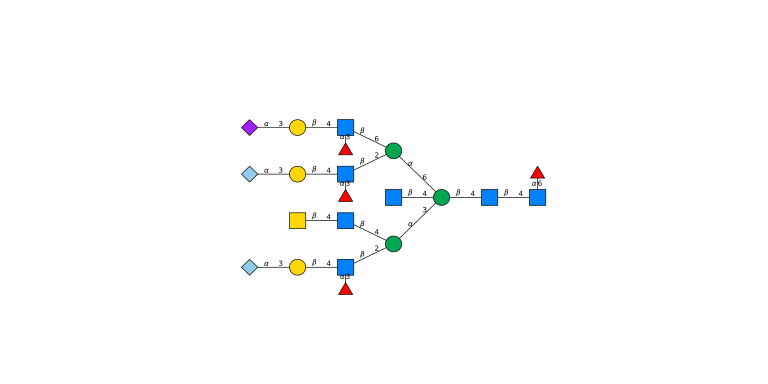
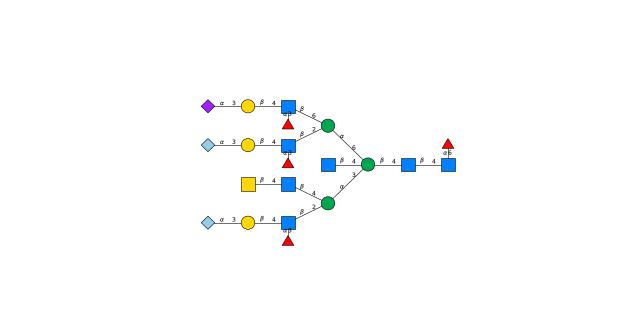
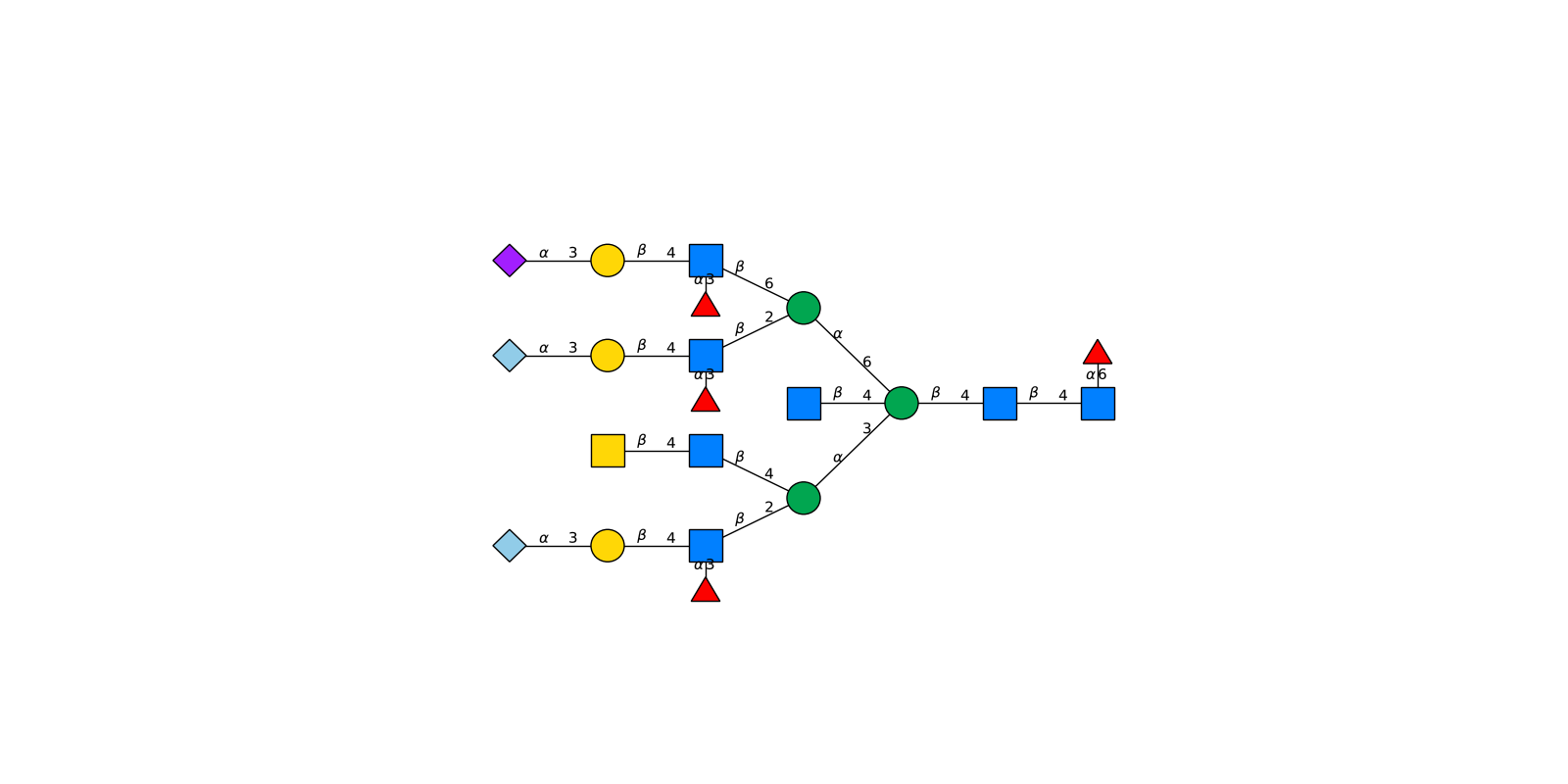
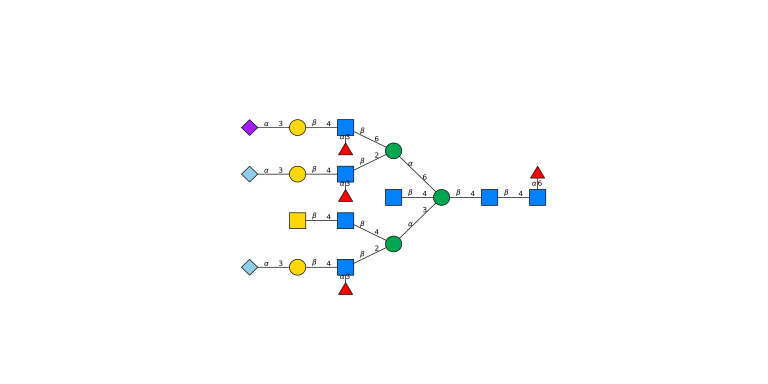
>>> iupac.loads('a-L-Fucp-(1-6)-[a-D-Neup5Ac-(2-3)-b-D-Galp-(1-4)-[a-L-Fucp-(1-3)]b-D-Glcp2NAc-(1-6)-[a-D-Neup5Gc-(2-3)-b-D-Galp-(1-4)-[a-L-Fucp-(1-3)]b-D-Glcp2NAc-(1-2)]a-D-Manp-(1-6)-[b-D-Glcp2NAc-(1-4)][b-D-Galp2NAc-(1-4)-b-D-Glcp2NAc-(1-4)-[a-D-Neup5Gc-(2-3)-b-D-Galp-(1-4)-[a-L-Fucp-(1-3)]b-D-Glcp2NAc-(1-2)]a-D-Manp-(1-3)]b-D-Manp-(1-4)-b-D-Glcp2NAc-(1-4)]?-D-Glcp2NAc')
>>>
(Source code, svg, png, hires.png, pdf)
Object-Oriented Interface
The high-level API is implemented using a set of cooperating types for converting between
glypy’s objects and IUPAC text formats. All of these objects provide these behaviors by calling them on the appropriate argument
Serialization
- class glypy.io.iupac.SubstituentSerializer(monosaccharides=None, substitution_rules=None, substituent_map=None)[source]
Build the textual encoding for the relevant substituents for a provided monosaccharide.
- Variables:
monosaccharide_reference (
dict) – Map base type toMonosaccharide
- class glypy.io.iupac.ModificationSerializer[source]
Build the textual encoding for the relevant modifications for a provided monosaccharide base type.
- class glypy.io.iupac.MonosaccharideSerializer(monosaccharides=None, substituent_resolver=None, modification_extractor=None)[source]
Serialize a
Monosaccharideobject to IUPAC text- Variables:
modification_extractor (
ModificationSerializer) – Convert modifications to a text listmonosaccharide_reference (
dict) – Map base type toMonosaccharidesubstituent_resolver (
SubstituentSerializer) – Convert substituents to a text list
- class glypy.io.iupac.LinkageSerializer(open_edge='-(', close_edge=')-', open_branch='[', close_branch=']')[source]
- class glypy.io.iupac.GlycanSerializer(monosaccharide_serializer=None, linkage_serializer=None)[source]
Converts a
Glycanstructure to IUPAC format.Also works on individual
Monosaccharideobjects, but will traverse any links they have to other nodes.- Variables:
linkage_serializer (
LinkageSerializer) – An object that converts aLinkobject into textmonosaccharide_serializer (
MonosaccharideSerializer) – An object that converts aMonosaccharideobject into text
Deserialization
- class glypy.io.iupac.ModificationDeserializer(modification_map=None)[source]
Parses modification signifiers from text into position,
Modificationpairs- Variables:
modification_map (
dict) – Mapping from text representation toModificationto provide additional names for the existing modification name mapping.
Derivatization
- class glypy.io.iupac.DerivatizationAwareMonosaccharideSerializer(monosaccharides=None, substituent_resolver=None, modification_extractor=None)[source]
A derivatization aware version of
MonosaccharideSerializerwhich deviates from the standard IUPAC code to encode derivatization.If a
Monosaccharideobject has a derivatizing substituent attached to it, as detected byhas_derivatization(), those substituent groups will normally be ignored. With this subclass, a single entry will be appended to the monosaccharide encoding joined by an “^” character. For example a permethylated hexose would be written “Hex^Me”.
Simplified Format
- class glypy.io.iupac.SimpleMonosaccharideSerializer(monosaccharides=None, substituent_resolver=None, modification_extractor=None)[source]
- class glypy.io.iupac.SimpleLinkageSerializer(open_edge='(', close_edge=')', open_branch='[', close_branch=']')[source]